Watercolor Color Flashcards: A Complete Guide for Creative Learning
When you're building educational materials for a homeschool environment, a playroom, or even a creative studio, the quality of your visual assets matters more than you might think. Watercolor Color Flashcards represent a specific category of design asset that bridges the gap between aesthetic appeal and functional learning. These aren't just pretty pictures on paper—they're carefully crafted 3 Part Cards designed to support color recognition, vocabulary building, and visual discrimination in young learners.
Understanding the 3 Part Card Format
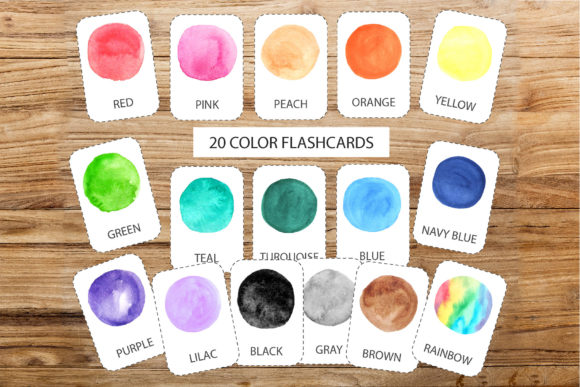
The 3 Part Card system originates from Montessori education, and it's a methodology that has stood the test of time for good reason. Each set includes a control card (showing the image with its label), a picture card (the image alone), and a label card (the word by itself). This structure allows children to self-correct as they match images to words, building both literacy and cognitive connections simultaneously. When you combine this proven educational framework with watercolor illustrations, you get something genuinely special—materials that feel intentional and beautiful rather than mass-produced and disposable.
The Watercolor Color Flashcards we're examining here deliver this format across 5 pages of printable content, with 9 cards per page. You receive both letter size (8.5" x 11") and A4 versions, which means whether you're printing at home in the United States or ordering from a copy shop internationally, the files are ready to go without resizing headaches. That kind of file preparation reflects professional design thinking—the kind that saves you time and frustration during production.
Why Watercolor Style Matters in Educational Materials
There's a reason watercolor textures have become so prevalent in modern design, from brand identity work to social media graphics. The medium carries warmth, organic texture, and a sense of handmade authenticity that flat digital colors simply cannot replicate. For children's educational materials specifically, watercolor illustrations feel approachable and artistic without being overwhelming. They introduce young learners to the idea that color itself has depth—a red isn't just red; it can have lighter washes, deeper concentrations, and subtle variations at the edges.
This visual richness matters because it trains the eye. Children who interact with thoughtfully designed color flashcards develop stronger observational skills. They begin noticing that "blue" encompasses cerulean, navy, and sky tones. The Watercolor Color Flashcards leverage this by presenting colors in a way that feels natural and inviting rather than clinical. It's the difference between showing a child a flat swatch of green and showing them a watercolor leaf where the pigment pools at the edges and fades toward the center.
From a design perspective, watercolor elements also photograph beautifully. If you're a blogger or content creator documenting your homeschool setup or playroom design, these cards add genuine visual interest to your images. They function as both educational tools and aesthetic props—a dual purpose that matters when you're curating a cohesive visual environment.
Print Quality and Production Considerations
Every image in this set is provided at 300dpi, which is the standard resolution for quality print output. However, your final results depend on several variables worth understanding. The paper you choose makes a significant difference. For flashcards that children will handle repeatedly, I recommend heavy weight paper—ideally card stock in the 80-110 lb range. Satin or matte finishes work best because they reduce glare while still allowing the watercolor details to read clearly.
Glossy paper, while it can make colors appear more vibrant, tends to show fingerprints and creates reflections that interfere with readability under certain lighting conditions. For educational materials that live in a playroom or classroom, matte card stock strikes the right balance between durability and visual clarity.
When printing at home, check your printer settings carefully. Select "high quality" or "best" output, and if your printer has a specific setting for card stock or heavy paper, enable it. The feed mechanism needs to accommodate thicker paper without jamming, and print heads need sufficient ink saturation to reproduce those subtle watercolor gradients accurately.
If home printing isn't delivering the results you want, local copy shops offer a reliable alternative. Request heavyweight matte card stock and ask to see a single page proof before committing to the full run. Online services like Staples also accept these PDF uploads, which can be convenient if you need laminated or professionally finished cards.
Practical Applications Beyond Homeschooling
While these Watercolor Color Flashcards are designed primarily as educational materials, their applications extend further than you might expect. Interior designers and staging professionals sometimes use curated educational prints as part of playroom or nursery decor. The 3 Part Card format, when displayed on a shelf or mounted in frames, creates an intentional visual arrangement that reads as both decorative and purposeful.
Small business owners in the children's product space—Etsy sellers, boutique toy shop owners, daycare providers—can use these printable cards as part of their inventory or classroom resources. The commercial-friendly format means you're investing in a design asset that serves multiple functions without requiring custom illustration work.
Content creators and bloggers in the parenting, education, or lifestyle space will find these cards useful for styled photography. Flat lays featuring watercolor educational materials perform well on visual platforms because they communicate intentionality and aesthetic awareness. Your audience notices when materials look thoughtfully chosen rather than randomly assembled.
Choosing and Evaluating Your Printable Set
Before purchasing any printable educational resource, consider your specific use case. If you're creating materials for a toddler, durability and simplicity matter most—thicker paper, possibly laminated, with large cards that small hands can manipulate easily. For older children working on reading skills, the label matching aspect of the 3 Part Card system becomes the primary value driver.
Evaluate the color accuracy of any preview images carefully. Watercolor reproductions can shift during printing, particularly in the warmer tones—reds, oranges, and yellows sometimes appear more muted in print than on screen. This is a universal printing reality, not a flaw in the design files themselves. Calibrating your monitor and using ICC color profiles for your printer can minimize these discrepancies.
Consider how many sets you need and whether the page layout supports efficient cutting. Nine cards per page is a practical arrangement that minimizes waste while keeping individual card sizes manageable. Straight edges and consistent dimensions across the set make cutting straightforward—use a paper trimmer rather than scissors for clean, professional results.
The inclusion of both main cards and image-with-label cards gives you flexibility in how you deploy the materials. Use the labeled versions during initial introduction, then transition to the unlabeled cards as children build confidence. This progressive approach mirrors how professional educators scaffold learning experiences, and having both formats in a single purchase eliminates the need for multiple resources.
Building a Cohesive Learning Environment
One often overlooked aspect of educational materials is visual consistency. When your color flashcards, alphabet posters, number charts, and other learning resources share a cohesive aesthetic, the learning environment feels intentional rather than chaotic. Watercolor Color Flashcards with their organic, artistic style can anchor an entire visual system. Pair them with other watercolor-themed printables—weather charts, shape cards, animal identification cards—to create a unified playroom or classroom aesthetic that feels curated and calm.
This consistency isn't just about aesthetics. Research in environmental design suggests that organized, visually coherent spaces support concentration and reduce cognitive overload in children. When materials look like they belong together, the learning environment communicates order and purpose—qualities that support focused engagement.
For homeschool families especially, this matters. Your home serves double duty as living space and learning space. Educational materials that integrate with your home's visual style rather than clashing with it reduce friction and make the learning environment feel natural rather than institutional. Watercolor Color Flashcards accomplish this beautifully, offering educational rigor wrapped in an aesthetic that respects both the learner and the living space.