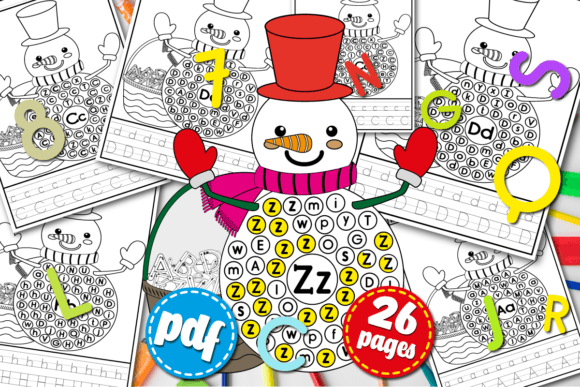
Alphabet Handwriting | Color by Letter: A Creative Workbook for Learning
When you're building a brand or a product for the education market, the assets you choose define the user experience. It’s not just about the content; it’s about how that content feels in the hands of the learner. The Alphabet Handwriting | Color by Letter collection is a design asset that bridges the gap between playful engagement and rigorous educational methodology. For designers, publishers, and educators, this 26-page resource isn't just a set of worksheets; it is a fully realized curriculum tool designed to make letter recognition intuitive and enjoyable for children ages 2-5.
Visual Style and Aesthetic Appeal
The visual personality of this workbook is defined by its clarity. In the world of early childhood education, visual noise is the enemy of focus. The layout utilizes an 8.5 x 11-inch format, which is the industry standard for printables, ensuring that these pages fit seamlessly into binders, printing queues, and laminating pouches. The design prioritizes high-contrast elements, allowing the "Color by Letter" sections to stand out clearly against the tracing guidelines.
Unlike complex serif fonts or overly stylized script fonts that might look beautiful on a wedding invitation but disastrous on a worksheet, this collection uses a clean, legible aesthetic. It functions almost like a sans serif font in its simplicity, stripping away unnecessary ornamentation to focus the child's eye on the shape of the letter. The visual hierarchy is strict: the target letter is prominent, the tracing paths are distinct, and the coloring zones are well-defined. This creates a calm, organized environment that encourages focus rather than distraction.
Practical Application in Educational Publishing
For the entrepreneur or content creator in the educational space, versatility is currency. This collection is Fully Editable in AI (Adobe Illustrator), which is a critical feature for anyone looking to customize content for a specific niche. Whether you are creating a winter activity book for kids ages 3-5 or a general alphabet coloring book for children, the vector-based nature of the files allows for infinite scalability without loss of quality.
Consider the practical workflow: You can easily adjust the line weights for different age groups—thicker lines for toddlers developing motor skills, and thinner lines for kindergarteners refining their penmanship. The workbook serves multiple functions simultaneously:
- Letter Tracing Worksheets for Kindergarten: The core utility, offering guided practice for handwriting.
- Find and Count Activities: Integrating math concepts with literacy.
- Alphabet Identification Activities: Moving beyond rote memorization to active recognition.
- Color by Letter for Preschool: Using color theory to reinforce memory.
This adaptability makes it a powerful design asset. It’s not just a static PDF; it’s a raw material for building a brand identity in the educational sector. If you are a small business owner selling on Etsy or Teachers Pay Teachers, having an editable master file allows you to create derivative products—such as printable puzzles for kids or winter worksheets for children—without starting from scratch.
Designing for Engagement and Retention
From a design strategy perspective, the "Color by Letter" mechanic is a brilliant engagement hook. It transforms a repetitive task—tracing the letter 'A' twenty times—into a game. This is where the asset shines in terms of audience engagement. By gamifying the learning process, you increase the time a child spends on the page, which translates to better learning outcomes and higher satisfaction for the parents purchasing your product.
The collection covers the full A-Z spectrum, ensuring Uppercase & Lowercase Identifying Letters are both addressed. This consistency is vital for brand perception. When a parent sees that a workbook is comprehensive and consistent from A to Z, they perceive the creator as professional and trustworthy. It signals that the product is a premium font resource, even though the medium is a worksheet. The attention to detail—ensuring every letter has corresponding tracing paths and coloring areas—demonstrates a commitment to quality that separates amateur hobbyists from serious publishers.
Technical Specifications and Workflow Integration
For the designer or marketer tasked with production, the technical specs matter. The 26-page count is substantial enough to offer value but manageable enough to print physically or distribute digitally. The fact that it is optimized for web design distribution (digital downloads) and print makes it a dual-threat asset.
When integrating this into a larger project, such as a tracing activities for kindergarten bundle, think about font pairings for your instruction text. While the activity itself is visual, the headers and instructions on your packaging or digital listing need to complement the playful nature of the workbook. A rounded modern typography style works well here—something that echoes the handwritten feel of the tracing guides without being illegible. Avoid overly corporate typefaces; instead, opt for friendly, approachable styles that match the energy of the alphabet letter identification tasks.
Furthermore, the inclusion of winter activities and seasonal elements suggests this is an excellent base for a seasonal marketing campaign. You can rebrand the core tracing and coloring pages to fit a holiday theme, extending the lifecycle of the asset. This is a smart move for content creators looking to maximize ROI on their design purchases.
Conclusion: A Tool for Modern Creators
Ultimately, Alphabet Handwriting | Color by Letter is more than just a set of papers; it is a toolkit for fostering literacy. It respects the developmental stage of the child while providing the flexibility that modern creatives and entrepreneurs demand. Whether you are a parent printing these for a rainy day, a teacher building a curriculum, or a designer creating a commercial writing workbook for children, this collection provides the high-quality foundation needed to succeed. It proves that functional design—focused on readability, recognition, and engagement—is always in style.